Most people buy a tankless water heater expecting endless hot water. Then winter hits, the showers slow to a trickle, and you start wondering what happened.
The reason? GPM. It stands for gallons per minute, and it measures how much hot water flow your heater can produce. When you pump it too hard, it drops.
Let’s talk about how to get that flow back—without wasting energy or replacing the whole system.
Quick Takeaways
- GPM (gallons per minute) measures how much hot water your tankless system can deliver.
- Actual GPM depends on temperature rise, unit power (BTU or kW), and water pressure.
- The colder the incoming water temperature, the lower your flow rate will be.
- A recirculation pump or system upgrade can improve effective GPM and reduce wait time.
- Proper installation and regular maintenance are key to sustaining maximum performance.
- Consult a licensed plumber to verify your gas line, venting, and plumbing setup.
What Determines GPM in a Tankless Water Heater
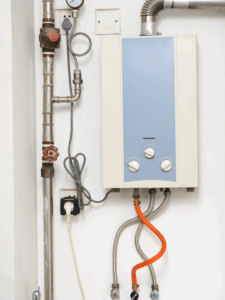 Your tankless water heater doesn’t have a fixed number. Its GPM rating changes with water temperature, flow demand, and unit size.
If your hot water slows down, one of these factors is working against you.
Flow Rate and Temperature Rise
Temperature rise is the difference between what comes in and what you want out.
Example: 120°F – 55°F = 65°F rise.
The bigger that number, the lower your flow rate. Your heater must work harder to heat colder water, which cuts your GPM.
Unit Capacity (BTU or kW Rating)
Every tankless unit has a power rating. Higher BTU or kilowatt ratings mean the heater can move more heat through the water each minute.
More heat per gallon = higher flow rate at the same temperature rise.
Water Pressure and Pipe Size
Low water pressure or narrow pipes choke flow. If your system drops below 40 psi, it can’t maintain full GPM. Corroded or undersized lines also limit flow, no matter how powerful your heater is.
Simultaneous Hot Water Demand
Every open fixture divides your available flow.
One shower feels fine. Two showers and a running dishwasher? Your 6 GPM unit is suddenly trying to push 8 GPM—and it can’t.
How to Increase GPM in a Tankless Water Heater
To pump more GPM, you need to reduce restrictions, improve heating, and keep pressure steady. These small steps can make your system feel brand new.
1. Install or Upgrade a Recirculation Pump
A recirculation pump keeps hot water moving through the pipes, so it’s ready when you turn the tap.
It doesn’t raise the unit’s true GPM, but it boosts usable flow and cuts waste. Perfect for larger homes or long runs of pipe.
2. Reduce Temperature Rise
Lower your water heater’s set temperature slightly—say from 125°F to 115°F. That 10-degree drop can raise your available flow rate by one or two GPM.
It’s simple physics: less rise, more flow.
3. Clean or Flush the Heat Exchanger
Scale builds up inside tankless heaters over time. That mineral crust narrows internal channels and kills flow.
Flushing once a year restores full heating capacity and keeps your tankless unit efficient.
4. Maintain Adequate Water Pressure
Check your water pressure with a cheap gauge from the hardware store. If it’s below 40 psi, ask a plumber about adjusting or replacing the pressure regulator.
Good pressure means stable water flow and consistent hot water supply.
5. Upgrade to a Higher-Capacity Unit
If your unit is undersized for your family’s hot water demand, even perfect maintenance won’t fix it. A larger BTU heater—or two smaller ones in cascade—can deliver more GPM at higher temperature rise.
6. Insulate Hot Water Pipes
Heat loss along the line forces your heater to work harder. Pipe insulation keeps the temperature steady, helping the system perform closer to its rated GPM.
How Recirculation Systems Help “Pump” More GPM
A recirculation system doesn’t increase the heater’s strength—it increases how fast you get hot water. Think of it as a shortcut between the heater and the tap.
What a Recirculation Pump Does
It circulates hot water through the pipes continuously or on demand. When you open a faucet, the hot water is already there No cold-water lag, no wasted gallons.
Types of Recirculation Systems
- Dedicated return loop: A separate pipe returns cooled water to the heater. Best performance, but needs extra plumbing.
- Crossover system: Uses your cold line as the return path—simple to install, good retrofit choice.
Efficiency Gains
Less water waste, faster delivery, and better comfort. Your heater seems to “pump more GPM” because the usable hot water arrives instantly.
Real-World Example
A family runs two showers (2.5 GPM each) and a dishwasher (1.5 GPM) at once.
That’s 6.5 GPM total demand.
Incoming water temperature: 55°F. Desired output: 120°F.
Temperature rise: 65°F.
Their 200,000 BTU unit delivers about 7 GPM at that rise—barely enough. After a year, scale buildup drops flow to 5.8 GPM.
They flush the unit, add a small recirculation pump, and the system recovers its full flow—steady hot water, no delay.
Common Mistakes That Reduce GPM
 Homeowners often blame the unit when the cause is setup or maintenance. Avoid these common problems:
- Ignoring inlet water temperature and sizing only by GPM rating.
- Running too many fixtures at once.
- Skipping the annual flush and letting scale build up.
- Using undersized gas or water lines.
- Setting output temperature too high, increasing rise unnecessarily.
Quick GPM Optimization Checklist
- Check your unit’s GPM at your target temperature rise.
- Measure your incoming water temperature in winter.
- Test home pressure (aim for 40–60 psi).
- Flush the heater yearly.
- Insulate long runs of hot pipe.
- Consider adding a recirculation pump.
- Talk to a licensed plumber before changing capacity.
FAQs
Does a recirculation pump increase actual GPM?
No—it improves delivery speed, not heater capacity. But it makes the flow feel faster.
Why does my tankless heater’s GPM drop in winter?
Colder inlet water increases temperature rise, reducing output flow.
Can I adjust my heater to get more flow?
Yes. Lower your temperature setting or limit simultaneous fixture use.
How often should I flush my tankless water heater?
At least once a year to remove mineral buildup and restore full GPM.
When should I consider a second unit?
If your family’s total hot water usage exceeds your heater’s GPM rating at your local inlet temperature.
Get the Flow You Paid For
 If your tankless water heater struggles to keep up, you don’t need to live with slow showers. Buddy’s Plumbing Excellence serves Akron, OH, and nearby areas.
We fix low flow, install recirculation systems, and make sure your system performs the way it should. You call. We come. It’s fixed. Guaranteed.
Schedule your tankless inspection today and get the flow you paid for.