You want hot water on demand. You do not want cold showers or a bloated gas bill. Getting the correct size tankless water heater fixes both.
Tankless units do not store water. They heat water as it flows. Two numbers set the size: flow rate in gallons per minute (GPM) and temperature rise in degrees Fahrenheit (°F).
Quick Takeaways
- Tankless water heaters are sized by flow rate (GPM) and temperature rise (°F) — not gallons.
- Average home needs 5–8 GPM for 2–4 simultaneous fixtures.
- Colder incoming water = higher temperature rise = larger unit required.
- Oversized units waste energy; undersized units can’t keep up.
- Use a manufacturer’s sizing chart or online tool to find your match.
- Always confirm with a licensed plumber before purchase or installation.
Why Proper Sizing Matters
Right sizing gives you a steady supply of hot water at your taps and showers. It also trims energy use, reduces strain on the burner, and helps the unit last longer.
- It prevents running out of hot water during showers or laundry.
- It improves energy efficiency and lowers utility bills.
- It extends the system life by reducing strain.
- It keeps water temperature steady during peak hot water usage.
How Tankless Water Heater Sizing Works
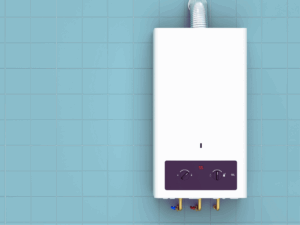 You size a tankless unit by how much hot water you need at once and how hot you need it. You set a flow target (GPM) and a temperature rise target (°F). Then you match a model that can meet both at the same time.
Tank vs. Tankless — What’s Different
A tank water heater stores hot water in gallons. A tankless water heater heats water as it passes through the heat exchanger. The rating focuses on GPM and temperature rise. Higher GPM supports more water fixtures at once.
Flow Rate (GPM)
Flow rate is how much hot water the unit can deliver each minute.
Typical fixture flow rates:
- Shower: 2.5 GPM
- Kitchen faucet: 1.0–1.5 GPM
- Washing machine: 2.0 GPM
Add the flow rates for the fixtures you expect to run at the same time. That sum is your target GPM.
Temperature Rise
Temperature rise = Desired output temperature – Incoming water temperature.
Example: 120°F (desired) – 55°F (incoming) = 65°F rise.
- Northern states often have colder groundwater temperature and need higher rise.
- Southern states often have warmer inlet temps and can use smaller units for the same flow.
How BTU Rating Ties It Together
The burner’s BTU rating shows how much heat the unit can produce. More BTUs let the unit push higher GPM at a larger temperature rise.
Do not pick by BTU alone. Always check the manufacturer’s GPM at a stated temperature rise.
Step-by-Step: How to Size a Tankless Water Heater
 You can size a tankless unit with a short list and simple math. Follow these steps and write down each number.
Step 1 – List All Hot Water Fixtures
Write the fixtures and appliances you might run at the same time. Count showers, tub fills, bathroom faucets, kitchen taps, dishwashers, and washing machines.
Step 2 – Add Up the Flow Rates
Use typical GPM values or the fixture’s actual rating. Add the GPMs to find your total simultaneous demand.
Example: two showers (2.5 + 2.5) and a kitchen faucet (1.0) ≈ 6.0 GPM.
Step 3 – Determine Temperature Rise
Check your region’s average incoming water temperature. In many homes, 120°F is a good desired output temperature. Subtract inlet temp from 120°F to get your temperature rise.
Step 4 – Match to Manufacturer Specs
Open the product sheet for each unit. Find the performance table. Look for GPM at your temperature rise. Choose a tankless unit that meets or slightly exceeds your GPM at that rise.
Step 5 – Confirm with a Licensed Plumber
A plumber will confirm gas line size, vent path, condensate needs, clearances, and local code. This step protects your budget and your warranty.
Rule-of-Thumb Sizing Chart
| Household Size | Typical Fixtures Used Simultaneously | Recommended Flow Rate | Suggested Unit Size |
|---|---|---|---|
| 1–2 People | 1 Shower + Faucet | 3–4 GPM | Small tankless |
| 3–4 People | 2 Showers + 1 Appliance | 5–7 GPM | Medium tankless |
| 5+ People | 3+ Fixtures | 8+ GPM | Large tankless or multiple units |
Use this as a quick filter. Then confirm with your actual fixtures and your actual incoming water temperature.
Common Sizing Mistakes
- Matching the old tank size in gallons instead of calculating water flow rate.
- Ignoring winter inlet temperatures and underestimating temperature rise.
- Missing peak hot water demand because you did not add simultaneous fixtures.
- Oversizing and paying for capacity you never use.
- Forgetting gas line capacity, venting, and condensate routing.
When You Might Need More Than One Unit
Some homes want long showers, big tubs, and back-to-back laundry loads. A single unit may struggle with that peak.
Two smaller units piped in parallel can handle higher flow more easily than one very large unit. This setup helps in homes with multiple bathrooms, body-spray showers, or frequent overlapping use.
Cost & Efficiency Factors
Bigger units cost more. They also need larger gas lines and may need more vent work. Small units cost less but may not meet your amount of hot water at peak.
- Larger units handle more fixtures but raise upfront cost.
- Oversized units can short-cycle at low flow and may waste energy.
- Right-sized units balance performance and bills.
- Many homes use 20–40% less energy than old tanks when they are sized and installed correctly. This is because the burner only works when you use water, which helps avoid standby losses.
Real-World Sizing Examples
These examples show how to size a tankless water heater with quick math. Replace the numbers with your fixtures and your climate.
Example A: Small Condo, Warm Climate
- Fixtures at once: 1 shower (2.5 GPM) + bathroom faucet (1.0 GPM) = 3.5 GPM
- Inlet temp: 70°F, desired 120°F → 50°F rise
- Target: 3.5 GPM @ 50°F rise
- Choice: Small unit that delivers ≥3.5 GPM at 50°F rise.
Example B: Family Home, Mild Climate
- Fixtures at once: 2 showers (5.0 GPM) + kitchen faucet (1.0 GPM) = 6.0 GPM
- Inlet temp: 60°F, desired 120°F → 60°F rise
- Target: 6.0 GPM @ 60°F rise
- Choice: Medium unit rated for ≥6.0 GPM at 60°F rise.
Example C: Large Home, Cold Climate
- Fixtures at once: 2 showers (5.0 GPM) + washing machine (2.0 GPM) = 7.0 GPM
- Inlet temp: 45°F, desired 120°F → 75°F rise
- Target: 7.0 GPM @ 75°F rise
- Choice: Large unit or two medium units in parallel to hit the number without strain.
These cases show how number of people, climate, and fixture choices change the size. The same house in a colder zone needs more capacity because the temperature rise increases.
Water Quality, Maintenance, and Performance
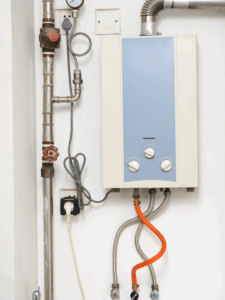 Size matters, and so does upkeep. Hard water can scale the heat exchanger and choke flow over time. A scaled unit heats slower and wastes fuel.
Add a scale filter if you have hard water. Flush the unit on the schedule in the manual. Clean the inlet screens. Keep the vent clear.
A well-maintained tankless water heater stays close to its rated GPM and holds set temperature better.
Gas, Venting, and Electrical Notes
Your heater for your home might be gas or electric. Gas units need a proper gas line, proper venting, and a safe condensate drain if they are condensing models.
Electric units need enough amperage and correct wire runs. Do not guess on these. A licensed plumber or electrician will check the loads and code.
Smart Ways to Reduce Peak Demand
You can often hit your number by trimming the peak.
- Install flow-efficient showerheads and aerators.
- Stagger laundry and dishwasher cycles.
- Set a realistic desired output temperature (120°F covers most homes).
- Fix drips and leaks that steal flow.
Cut a little demand and you may buy a smaller unit without losing comfort.
Quick Sizing Checklist
- List fixtures used at the same time.
- Add up total gallons per minute (GPM).
- Find your incoming water temperature.
- Calculate temperature rise to your setpoint (often 120°F).
- Check manufacturer specs for GPM @ temperature rise.
- Confirm gas line, vent, and install details with a licensed plumber.
FAQs
What happens if my tankless water heater is too small?
It will not meet demand. Water turns lukewarm or cold when more fixtures run.
Can I just match my old tank’s gallon size?
No. Tanks use gallons. Tankless units use flow rate and temperature rise. You must size by GPM at your rise.
What’s a good GPM for a 3-bathroom house?
Many 3-bath homes land in the 7–9 GPM range. Your exact number depends on fixture flow, the amount of hot water you use at once, and your incoming water temperature.
How do I find my incoming water temperature?
Use a local groundwater temperature map or take a winter reading at a cold tap with a thermometer.
Do I need a plumber to size it?
Yes. A plumber checks gas line size, vent runs, combustion air, and code rules. This step avoids returns and rework.
Can I use multiple tankless units?
Yes. Two units in parallel can handle high hot water demand better than one large unit.
Need Help Sizing? We’ll Handle It.
 Buddy’s Plumbing Excellence is your Fixed-Right-The-First-Time plumber in Akron, OH and nearby areas. We size your tankless water heater, install it cleanly, and stand behind the work.
You call. We come. It’s fixed. Guaranteed.
Get your free tankless sizing consultation today.